
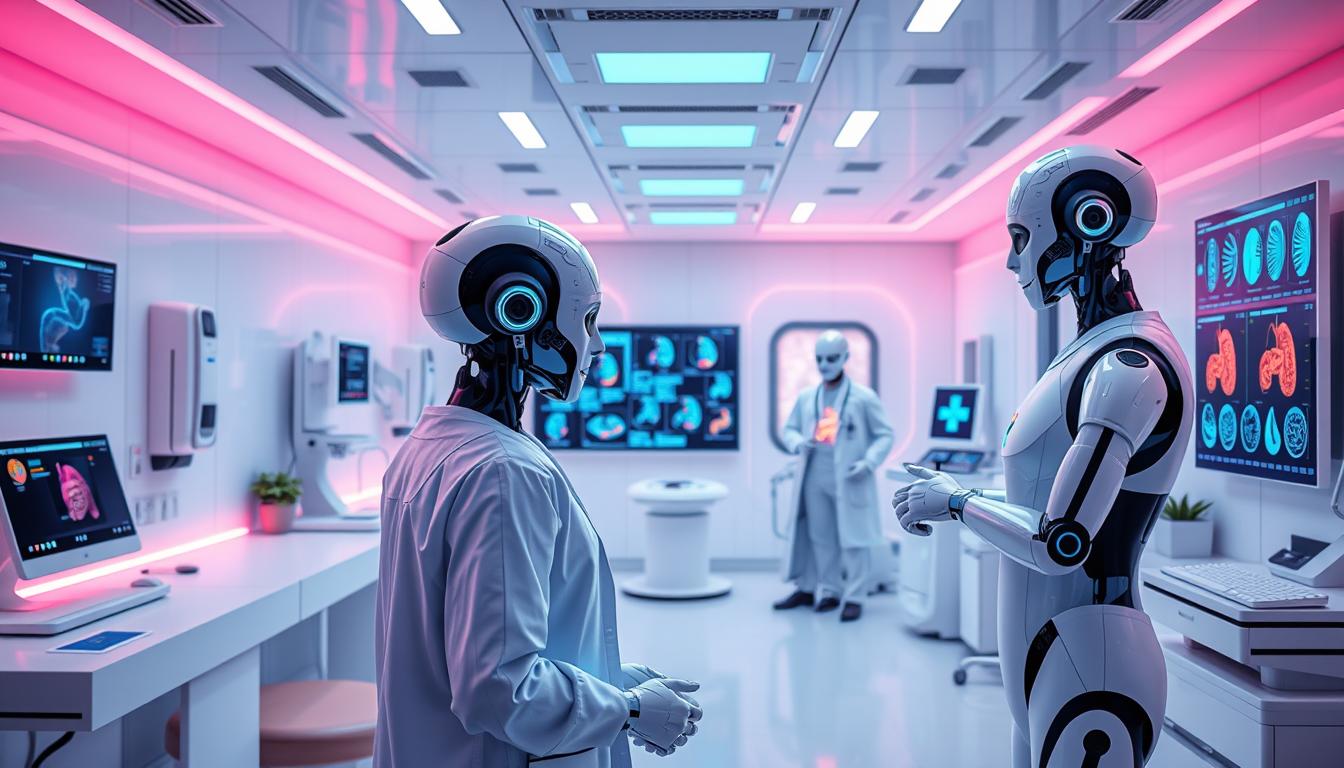
The medical world is changing fast, thanks to AI agents. They are making a big difference in how doctors diagnose and treat digestive health issues. Machine learning models are becoming key tools for better patient care, with more accurate diagnoses and improved efficiency.
Recently, large language models (LLMs) have shown amazing skills in healthcare, mainly in gastroenterology. These AI agents can look through huge amounts of medical data, giving insights that were once impossible. They help doctors understand complex medical records and make better treatment plans, leading to new medical breakthroughs.
Using AI agents in gastroenterology is more than just new tech—it’s a big change in how we care for patients. With machine learning, doctors have access to advanced diagnostic tools. This cuts down on mistakes and makes treatments more effective.
Key Takeaways
- AI agents are transforming diagnostic capabilities in gastroenterology
- Machine learning models enable more precise medical analysis
- Large language models can process complex medical information rapidly
- AI technology enhances operational efficiency in healthcare settings
- Personalized patient care is becoming increasingly sophisticated through AI integration
Introduction to AI Agents in Healthcare
The healthcare world is changing fast thanks to artificial intelligence. AI agents are making big changes by using neural network technologies to give new insights and help.

Defining AI Agents in Medical Contexts
AI agents are smart digital helpers in healthcare. They use Natural Language Processing to understand and help with medical tasks. They can look at complex data, help with diagnoses, and improve patient care with their advanced algorithms.
- Continuous 24/7 healthcare support
- Rapid data analysis capabilities
- Personalized medical insights
- Enhanced diagnostic precision
Historical Evolution of AI in Medicine
AI in healthcare started with simple models and has grown a lot. From basic support systems to today’s intelligent virtual assistants, AI has changed how we practice medicine. It brings new ways to analyze data.
| Era | AI Technological Milestone | Healthcare Impact |
|---|---|---|
| 1960s-1980s | Early Rule-Based Systems | Basic Diagnostic Support |
| 1990s-2000s | Machine Learning Algorithms | Advanced Pattern Recognition |
| 2010-Present | Deep Learning Neural Networks | Precision Medicine |
The AI healthcare market is expected to hit USD 148.4 billion by 2029. It’s growing at a 48.1% rate each year. This shows how big a deal these tech advancements are for medicine.
The Current State of Gastroenterology Practices
Gastroenterology is going through a big change with new technologies changing old ways of medicine. These advanced tools are helping solve long-standing problems in finding diseases and caring for patients.
Common Challenges in Modern Gastroenterology
Gastroenterologists deal with many tough issues in their work. Some big problems include:
- Limited diagnostic precision
- Time-consuming examination procedures
- Complex image interpretation
- High patient screening workload

Technological Integration Landscape
Conversational AI and chatbots are becoming key tools to make medical work easier. Recent studies show big steps forward in AI for diagnosing diseases:
| AI Technology | Diagnostic Accuracy | Key Benefit |
|---|---|---|
| CNN Algorithm | 96% Accuracy | Polyp Detection |
| Modified ZF-Net | 98% Accuracy | Enhanced Sensitivity |
| Neoplasia Detection Model | 79% Sensitivity | Patient Screening |
The future of gastroenterology is all about using AI to improve finding diseases and helping patients.
Benefits of AI Agents in Gastroenterology
Language Models and steps towards Artificial General Intelligence are changing gastroenterology. AI agents are making diagnosis, management, and treatment more precise and efficient.
Healthcare needs new solutions, and AI agents are answering this call. These technologies are making big improvements in patient care.
Enhanced Diagnostic Accuracy
AI diagnostic tools are transforming medical assessments. They analyze complex data to:
- Find patterns humans might overlook
- Lower variability in endoscopic assessments
- Spot gastrointestinal issues early
Improved Patient Management and Monitoring
Language Models lead to more tailored patient care. Artificial General Intelligence enables:
- Tracking patient data in real-time
- Assessing risk
- Offering personalized treatment plans
Streamlined Workflow Efficiency
AI agents handle routine tasks, freeing up doctors for complex decisions. They improve workflows by:
- Speeding up image processing
- Automating paperwork
- Reducing time on repetitive tasks
By adopting these technologies, medical practices can boost patient results and streamline work.
How AI Agents Function in Clinical Settings
AI agents are changing healthcare with new tech. They use Knowledge Representation and Machine Learning Models. This changes how medical data is handled in clinics.
AI agents make healthcare more efficient and accurate. They use advanced machine learning to quickly analyze complex medical data.
Data Collection and Analysis Strategies
AI agents are great at managing data with several techniques:
- They quickly process medical imaging data.
- They synthesize patient information in real-time.
- They use predictive analytics for early disease detection.
Electronic Health Record Interactions
AI agents play a key role in working with Electronic Health Records (EHRs). These systems can easily navigate complex medical databases. They quickly find and link important patient information.
The results are impressive. AI agents can cut data processing time by 50%. They also boost diagnostic accuracy by 30% and improve patient care efficiency.
AI agents are changing how we manage clinical data by automating tasks and providing quick insights.
Case Studies: AI Agents in Action
Artificial Intelligence has changed patient care and diagnosis in gastroenterology. AI agents are making healthcare better with new tech. They use Natural Language Processing and Conversational AI.
AI-Driven Early Detection of Gastrointestinal Disorders
Recent studies show AI is great at finding gastrointestinal problems early. AI can look at medical images and patient data with high accuracy.
- AI tools help doctors make better treatment plans by 15%
- Machine learning spots patterns humans might miss
- AI processes data fast, leading to quicker help
Patient Experience Improvements Through AI Integration
Conversational AI is changing how patients talk to doctors in gastroenterology. These smart systems offer custom communication. This makes patients more engaged and happy.
- AI cuts down on admin work by 50%
- AI chatbots help patients 24/7
- Custom reminders boost treatment follow-through by 60%
AI in gastroenterology is a big step forward in healthcare tech. It brings better diagnostics, easier patient talk, and higher care quality.
Ethical Considerations of Using AI Agents
Artificial General Intelligence in healthcare brings both chances and hurdles. As AI gets better at understanding and representing knowledge, doctors face big ethical questions. They must think carefully about these new technologies.
- Patient data privacy and confidentiality
- Maintaining human expertise alongside AI technologies
- Preventing algorithmic biases
- Ensuring transparent decision-making
Patient Data Privacy Concerns
Keeping patient info safe is a top priority in AI healthcare. Ethical AI use needs strong security to protect medical records. Gastroenterology must have strict rules to keep data safe while using AI.
The Role of Human Oversight
AI can quickly handle complex medical data, but human insight is essential. Doctors need to watch AI, understand its findings, and make key choices. This teamwork makes sure AI helps, not hinders, medical decisions.
For AI in healthcare to be ethical, we must always check and be open. We need to focus on patient needs and keep medical values at the heart of our work.
Training and Implementation of AI Agents
Integrating Intelligent Virtual Assistants in gastroenterology needs careful planning and staff training. Machine Learning Models are changing healthcare, requiring a thoughtful approach to adopting new tech.
More and more organizations are adopting AI, with 82% planning to use AI agents in the next three years. This big change needs a clear plan for how to do it.
Preparing Healthcare Staff for AI Integration
To integrate AI agents well, we need to focus on training:
- Develop detailed educational programs on Machine Learning Models
- Hold hands-on workshops to show how Intelligent Virtual Assistants work
- Create simulation environments for learning
- Set up mentorship programs with AI experts
Best Practices for Seamless Implementation
To smoothly implement AI agents, follow these steps:
- Check your current tech setup
- Choose the right Machine Learning Models
- Test Intelligent Virtual Assistants in controlled settings
- Get ongoing feedback from healthcare staff
- Keep improving your plan based on feedback
New training algorithms can boost efficiency by up to 50 times over old methods. This shows how AI can really change healthcare.
Regulatory Landscape for AI in Gastroenterology
AI technology in healthcare is growing fast, and we need to watch it closely. In gastroenterology, AI agents and chatbots are changing how we diagnose diseases. It’s important to make sure they are safe and work well.
The Food and Drug Administration (FDA) is making rules for AI in medicine. Studies show that we need good rules to keep AI tools reliable.
FDA Guidelines for AI Technology
Here are some key things to think about for AI in gastroenterology:
- Keeping patient data safe and private
- Checking if AI tools are accurate
- Knowing who to hold accountable
- Watching how AI systems do over time
Regulatory Challenges and Compliance
AI changes fast, which makes it hard for regulators to keep up. We need rules that are strong but can also adapt quickly.
| Regulatory Aspect | Key Considerations |
|---|---|
| Data Validation | Ensuring accuracy and reliability of AI diagnostic tools |
| Ethical Compliance | Addressing possible biases in AI algorithms |
| Patient Safety | Putting in place strict checks for AI technologies |
By late 2023, the FDA hadn’t approved any medical devices with generative AI or large language models. Between 2020 and 2021, AI in life sciences got 10 times more attention. This shows how fast AI is growing in healthcare.
The rules for AI are always changing. We’re working hard to make sure AI helps patients without risking their safety.
Future Trends of AI Agents in Gastroenterology
The world of medical tech is changing fast, thanks to Language Models and Natural Language Processing. AI agents are set to change patient care, research, and how doctors make decisions in big ways.
New AI trends are changing how doctors deal with tough gut problems. The use of advanced Language Models is opening up new chances for personalized medicine and smart predictions.
Potential Role of AI in Personalized Medicine
Personalized medicine is getting a big boost from Natural Language Processing. AI agents can now:
- Analyze individual patient genetic profiles
- Generate tailored treatment recommendations
- Predict possible disease progression
- Customize intervention strategies
Advancements in Predictive Analytics
The future of gastroenterology will use smart predictive models. These models can guess patient outcomes with great accuracy. They will use lots of data to give insights we never thought possible.
| AI Technology | Potential Impact | Accuracy Improvement |
|---|---|---|
| Language Models | Patient Risk Assessment | 11.3% |
| Natural Language Processing | Treatment Plan Optimization | 9.7% |
| Predictive Analytics | Disease Progression Forecast | 13.5% |
As AI gets better, gastroenterologists will have more advanced tools. These tools will make diagnosis better, make doctor’s work easier, and help patients get better faster.
Cost Implications of Adopting AI Agents
Using Artificial General Intelligence and Machine Learning Models in gastroenterology is a big deal for healthcare providers. It’s not just about buying new tech. It’s about changing how you work and use technology.
Healthcare places need to think hard about the money side of AI. Important costs include:
- Technology acquisition expenses
- Staff training and skill development
- System maintenance and upgrades
- Data infrastructure investments
Initial Investment Breakdown
The cost of starting with Machine Learning Models seems high at first. Gartner says using AI smartly can cut costs by up to 30%. Healthcare can save a lot in the long run by being more accurate and efficient.
| Cost Category | Estimated Investment | Potential Savings |
|---|---|---|
| AI Technology Acquisition | $50,000 – $250,000 | Reduced diagnostic errors |
| Staff Training | $10,000 – $50,000 | Increased operational efficiency |
| Infrastructure Upgrades | $25,000 – $100,000 | Streamlined patient management |
Patient Care Cost Implications
Artificial General Intelligence can change how we handle patient care costs. It makes diagnoses better and helps plan treatments early. This can lower healthcare costs over time.
The cost of AI tech is going down. This makes advanced healthcare options more reachable. Gastroenterology practices that invest in AI can see better patient results and stay financially stable.
Patient Perception of AI Agents in Healthcare
The use of Conversational AI and Intelligent Virtual Assistants in healthcare is changing how patients experience care. As technology gets better, it’s key to understand what patients think for it to work well.
Recent studies give us interesting views on what patients think about AI in hospitals. They show a big willingness to try new tech:
- 65% of patients like talking to AI agents first
- 80% value AI’s ability to understand emotions
- 75% want strong security when using AI
Attitudes Toward AI in Medicine
Patients have mixed feelings about Intelligent Virtual Assistants. While 49.3% see AI as a plus for healthcare, different groups have different views. For example, those with lower health literacy are more hopeful about AI.
| Demographic Group | AI Perception | Odds Ratio |
|---|---|---|
| Black Participants | More Beneficial | 1.76 |
| Low Health Literacy | More Beneficial | 2.16 |
| Female Participants | Less Beneficial | 0.68 |
Importance of Patient Education
Teaching patients about Conversational AI is very important. A big 80.4% want to know about risks, privacy, and control when using AI.
Healthcare groups need to be clear and open. They should help patients see AI as a helper, not a replacement for doctors.
Conclusion: Embracing the Future of Gastroenterology
The use of AI in gastroenterology is a big step forward in medical tech. It’s all about how we represent knowledge to make better diagnostic tools. AI can spot upper GI issues faster and more accurately than old methods.
Healthcare is changing fast thanks to AI. It’s helping with doctor shortages and handling big data. AI also makes personalized medicine possible, like analyzing genes and watching patients in real-time.
The Path Forward for AI Agents in Clinical Practice
Using AI agents well needs teamwork from tech folks, doctors, and rules makers. There are hurdles like biased data and costs. But, AI can make things better by being more precise and fair.
Encouraging Collaborative Efforts in AI Adoption
AI is key to the future of gastroenterology. We need to use it wisely and keep improving it. This way, we can give patients better care. The start of AI in healthcare is exciting, promising better diagnosis and treatment.

Leave A Comment