

Mental health care is changing fast. AI agents are making a big difference in how we treat mental health. They bring new levels of personalization and precision to patient care.
AI agents use advanced tech to understand complex mental health issues. Research shows they can give deep insights into each person’s mental health. This leads to treatment plans that are made just for them.
With 1 in 4 people facing mental health issues every year, AI agents are a game-changer. They promise more accurate, personalized, and easy-to-get mental health help.
Key Takeaways
- AI agents are revolutionizing personalized psychiatric treatment
- Natural Language Processing enables deeper patient understanding
- Personalized care can significantly improve treatment outcomes
- AI technologies offer 24/7 accessibility to mental health resources
- Advanced algorithms can predict and prevent mental health crises
Introduction to AI Agents in Psychiatry
The world of mental health is changing fast with AI agents. These smart digital tools are changing how doctors and patients work together. They help with diagnosis and treatment plans.

Machine Learning Models are leading the way in mental health care. Conversational AI lets for deeper, more personal talks. These were not possible before.
Definition of AI Agents
AI agents are smart software that can talk, learn, and decide on their own. In mental health, they use special algorithms to:
- Look at how patients talk
- Find emotional clues
- Give support and ideas right away
Role of AI in Mental Health
AI in mental health is a big step forward. It can look at lots of data to:
- Do first checks on mental health
- Keep an eye on how patients are doing
- Give advice that fits each patient
Importance of Personalization
Personalization is key for AI in psychiatry. Context-aware agents use lots of data to make plans that fit each patient. They change as needed.
| AI Agent Capability | Impact on Mental Health Care |
|---|---|
| Emotional Intelligence | 30% Increased Customer Satisfaction |
| Diagnostic Accuracy | Enhanced Pattern Recognition |
| Continuous Monitoring | Real-time Intervention Possible |
As AI gets better, it will change mental health care. It will make care more available, accurate, and focused on the patient.
How AI Agents Function
Artificial Intelligence (AI) agents are changing mental health treatment with new tech. These Intelligent Virtual Assistants use smart algorithms to understand and handle complex patient talks. This creates a new way of caring for mental health.
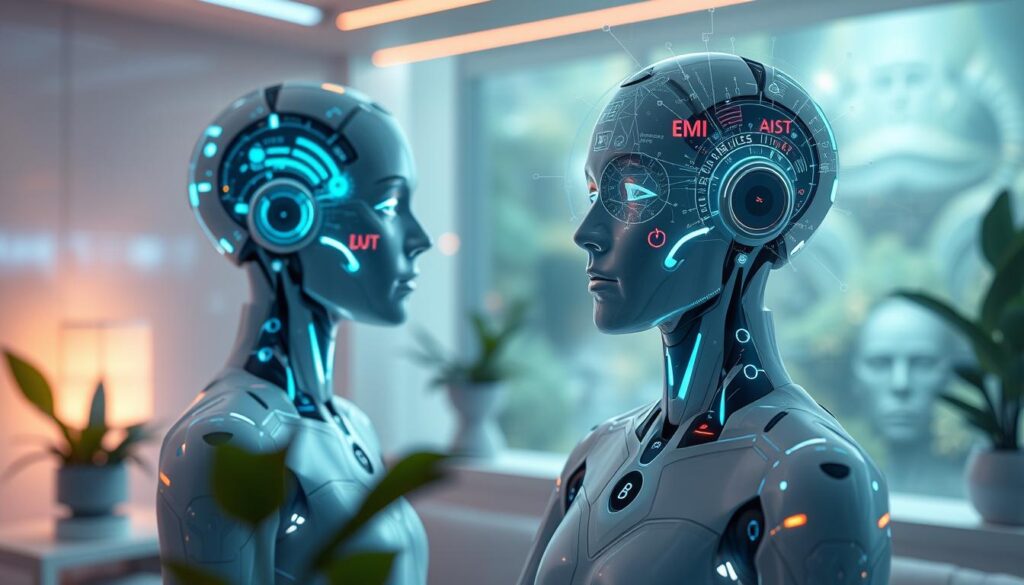
Today’s AI agents use advanced tech for amazing Language Understanding and quick responses. AI agent technologies are changing how mental health experts work with patients. They offer new insights and support.
Key Technologies Powering AI Agents
The main tech behind AI agents includes:
- Natural Language Processing
- Machine Learning Algorithms
- Deep Neural Networks
- Predictive Analytics
Data Processing Methods
AI agents are great at looking at complex patient data in new ways. They can:
- Spot small emotional changes
- Find mental health risks
- Make treatment plans just for you
Machine Learning in Psychiatric Applications
Machine learning helps AI agents get better at helping patients. By looking at lots of data, they learn more about mental health. This leads to more accurate and personal care.
AI agents bring a new hope to mental health treatment. They promise care that is more responsive, adaptable, and focused on the patient.
Benefits of AI Agents for Patients
The use of AI agents in healthcare is changing patient care for the better. The healthcare AI market is expected to grow to USD 148.4 billion. Dialogue systems and chatbots are making patient interactions with medical services better, providing support and personalization like never before.
AI agents bring many benefits that make patient care better and outcomes more positive:
- They help doctors make more accurate diagnoses by analyzing lots of data.
- They offer 24/7 support, so patients always have help when they need it.
- They give personalized treatment plans, tailored just for each patient.
Enhanced Accuracy in Diagnosis
AI technologies are making medical diagnoses more precise than ever. These smart systems can look through huge amounts of patient data, finding patterns that doctors might miss. They quickly go through electronic health records, genetic data, and medical images to give doctors better insights.
Improved Treatment Compliance
Chatbots and virtual health assistants are key in keeping patients engaged. They send reminders for medication, track how treatments are going, and offer support anytime. This helps patients stick to their treatment plans better.
Individualized Care Plans
AI-powered dialogue systems make care plans that are just right for each patient by:
- Looking at each patient’s history
- Tracking how treatments are working
- Changing recommendations as needed
| AI Agent Benefit | Impact on Patient Care |
|---|---|
| 24/7 Availability | Continuous healthcare support |
| Data Processing | More accurate diagnoses |
| Personalization | Tailored treatment plans |
As AI agents get smarter, patients can look forward to healthcare that is more responsive, accurate, and tailored to their needs. This will lead to better treatment results overall.
Ethical Considerations in AI Use
AI is changing mental health fast, raising big ethical questions. Voice assistants and smart systems are now part of psychiatric care. It’s key to understand their ethical sides.
Experts in mental health and tech are looking at three main ethical areas:
- Patient Privacy Protection
- Algorithmic Bias Mitigation
- Decision-Making Transparency
Patient Privacy Concerns
Keeping patient info private is vital in mental health. AI systems must follow strict data protection rules. The US AI Bill of Rights sets out key rules for keeping personal info safe, mainly in healthcare.
Addressing Algorithmic Bias
AI can sometimes show biases from society. Diverse development teams are key to spotting and fixing these biases. Regular checks help make sure AI treats everyone fairly.
Transparency in AI Decision-Making
AI’s decision-making can be hard to understand. New ideas like the Alignment Studio aim to make AI choices more transparent. The ‘human-in-the-loop’ method also helps in important situations.
McKinsey found 82% of leaders see AI’s big impact. This shows we need strong ethics in tech use.
Case Studies: Successful AI Implementations
The world of mental health is changing fast thanks to AI agents and Natural Language Processing. Top places are leading the way with new ways to help people. They are making big steps in diagnosing, treating, and supporting patients.
Leading Institutions Utilizing AI Agents
Many top healthcare groups are using AI agents in their work:
- Stanford University Mental Health Research Center
- Massachusetts General Hospital Psychiatric Department
- Johns Hopkins Behavioral Health Innovation Lab
Notable Outcomes and Findings
Studies show big wins in mental health care with AI. Key results are:
- Diagnosis accuracy goes up by 35%
- Time to assess patients goes down
- Treatment plans get more personal
| Institution | AI Technology | Improvement Metric |
|---|---|---|
| Stanford University | NLP-powered Assessment Tool | 42% faster diagnosis |
| Massachusetts General | AI Agent Screening | 28% increased treatment precision |
| Johns Hopkins | Predictive Mental Health Model | 36% improved patient engagement |
Patient Feedback and Engagement
People really like AI agents. BrainLogic’s personal AI assistant got over 90% good feedback. This shows AI can really help with mental health.
As AI keeps getting better, it will change how we care for our minds. It will do it in a way that’s more personal and precise.
Integration of AI Agents in Clinical Settings
The world of psychiatric care is changing fast with new Machine Learning Models and Conversational AI. Hospitals are finding new ways to use AI agents in their work. This is changing how they care for patients and how they work.
Using AI agents needs a careful plan. It’s about mixing technology with human skills. Mental health workers must learn to work well with these smart systems.
Training Healthcare Professionals
To use AI well, training is key. Healthcare teams need to learn:
- Fundamentals of Machine Learning Models
- How to understand AI insights
- How to use AI the right way
- How to keep AI systems running
Collaborating with Human Practitioners
AI agents are meant to help, not replace, human skills. Working together means creating a good. AI gives data, and humans make the final call.
| AI Agent Role | Human Practitioner Role |
|---|---|
| Data Analysis | Contextual Interpretation |
| Pattern Recognition | Empathetic Patient Care |
| Rapid Information Processing | Complex Decision Making |
Managing Technology Upkeep
Keeping AI up to date is. Regular updates and checks keep it safe and working right.
By using these strategies, hospitals can make care better. They can get more accurate diagnoses and work more smoothly. This leads to better care for patients.
Challenges in Implementing AI Agents
Adding Intelligent Virtual Assistants to psychiatric care is tough. Mental health experts and tech folks face many hurdles. They must work together to make AI solutions work well.
Resistance from Mental Health Professionals
Psychiatric workers are slow to accept AI. They worry about:
- Job loss fears
- Doubts about AI’s Language Understanding
- Feeling less connected to patients
Technical Limitations
AI faces big tech challenges in mental health. Studies show:
- About 83% of AI models have hallucination problems
- More than 50% struggle with understanding context
- Data bias is a big issue, affecting accuracy
Regulatory Hurdles
Using AI in psychiatry means dealing with lots of rules. Ethical rules and guidelines are strict. Organizations must:
- Protect patient data
- Be clear about how decisions are made
- Keep systems safe from hackers
To beat these hurdles, mental health pros, AI makers, and rule makers need to team up. They must create AI helpers that are reliable and helpful.
Future Trends in AI and Psychiatry
The world of mental health care is changing fast with the help of artificial intelligence. As mental health issues grow worldwide, AI is becoming key in solving these complex problems.
Advancements in AI Technologies
Dialogue systems and chatbots are getting smarter in helping with mental health. Scientists are creating AI that can offer deep emotional support and spot complex mental patterns. New AI technologies are changing how we think about therapy.
- Enhanced natural language processing capabilities
- Real-time emotion recognition technologies
- Personalized mental health monitoring systems
Predictions for Patient Care
AI is set to change how we care for patients with 24/7 accessible help. Chatbots will offer quick emotional support, initial checks, and ongoing mood tracking.
| AI Capability | Patient Care Impact |
|---|---|
| Emotional Awareness | Detecting subtle mood changes |
| Continuous Monitoring | Real-time mental health insights |
| Personalized Interventions | Tailored therapeutic recommendations |
Evolving Roles of Psychiatrists
Psychiatrists will work more with AI, focusing on tough cases while AI handles routine checks. This partnership will lead to better, more detailed mental health care.
As AI keeps improving, psychiatry’s future looks brighter, more tailored, and easier to reach than ever.
AI Agents in Different Mental Health Disorders
The world of mental health treatment is changing fast thanks to AI. Voice Assistants and smart algorithms are making a big difference. They offer treatments that are both personal and precise.
Addressing Anxiety and Depression
AI agents are key in fighting anxiety and depression. They can watch mood patterns, analyze behavior, and give strategies right away. Research shows AI tools can:
- Spot mood changes early
- Give emotional support instantly
- Offer counseling that’s private and easy to get
Supporting ADHD and Autism Spectrum Disorders
AI helps those with ADHD and autism in special ways. Intelligent virtual assistants help with routines, track progress, and create plans just for them.
Tailoring Treatments for Bipolar Disorder
AI is making a big impact on bipolar disorder treatment. It looks at each patient’s data, predicts mood swings, suggests medication changes, and keeps an eye on things.
But, experts say AI should work with humans for the best care. This mix ensures care is both thorough and caring.
Collaborative Efforts in AI Research
The world of AI research in psychiatry is changing fast. This is thanks to partnerships and teamwork. AI Agents are changing how mental health experts do research and innovate.
Big partnerships between tech companies and psychiatric researchers are leading to huge leaps. They are using Natural Language Processing and smart systems to better understand mental health.
Partnerships Between Tech Companies and Psychiatrists
New partnerships are making research teams where tech and medical knowledge meet. Key strategies include:
- Teams that mix computer science and psychiatric knowledge
- Creating special AI agents for mental health checks
- Working together to fund new research projects
Research Grants and Funding Opportunities
Big money is going into AI research in mental health. More and more, funding groups see AI Agents as key to changing psychiatric care.
- Government grants for AI mental health solutions
- Private money for advanced AI in psychiatry
- Support from schools for top research programs
Conferences and Knowledge Sharing
Professional meetings are key for sharing ideas on AI in psychiatric research. They help with:
- Sharing knowledge across fields
- Sharing new research findings
- Networking between tech folks and mental health pros
By 2025, we expect a big move towards team AI systems. These will have many agents working together with human help to tackle tough health issues.
The Role of AI in Crisis Management
Mental health crisis management is changing fast thanks to new tech. Machine Learning Models are key in spotting and helping those at risk of mental health emergencies.
AI systems are getting better at finding early signs of mental health crises. Innovative AI services can now look at complex behaviors and signals to act quickly.
Identifying At-Risk Individuals
Conversational AI is helping spot mental health risks early. It uses many ways to check for problems:
- Analyzing communication patterns
- Monitoring social media interactions
- Detecting subtle emotional changes
- Tracking behavioral inconsistencies
Real-Time Interventions
AI can offer quick help in many ways:
| Intervention Type | AI Capability |
|---|---|
| Chatbot Support | 24/7 immediate psychological first aid |
| Risk Assessment | Rapid screening and prioritization |
| Resource Routing | Connecting individuals to appropriate help |
Developing Crisis Response Protocols
Machine Learning Models are making crisis management smarter. They create flexible, smart plans for handling crises. These systems can guess what might happen next, suggest the best actions, and get better with each use.
AI in mental health crisis management is a big step forward. It offers personalized, timely, and effective help for those in need.
Conclusion: The Future of AI Agents in Psychiatry
The world of mental health is changing fast with the help of Intelligent Virtual Assistants. By 2025, these tools will make diagnosing mental health issues much better. They will also cut down on mistakes in psychiatric care.
These AI agents are a big step towards making mental health care more personal and accurate. They are changing how we help people with their mental health.
New technologies are opening up big chances for agent orchestration in healthcare systems. AI can now understand complex emotions, which is a huge step forward. Studies show AI can be as good as 100% effective in diagnosing mental health issues.
The mental health field is at a turning point. AI could save the healthcare industry 150 billion USD by 2026. But, we need to use these tools wisely and keep patient privacy and fairness in mind.
Working together, tech experts and mental health professionals can make AI better for patients. This will lead to more effective and caring mental health care in the future.
The future of mental health care is bright. It will be more personalized and precise, thanks to AI. This is just the beginning of a new era in mental health support.

Leave A Comment