

Mental health issues affect millions, making new solutions urgent. AI Agents are changing psychiatric care. They offer personalized treatment plans that fit each patient’s needs perfectly.
Artificial General Intelligence is changing mental health care. It gives insights that old methods can’t. Machine Autonomy lets AI systems understand complex data. They can predict risks and create custom treatments.
Technology and mental health are merging in exciting ways. AI Agents can look at lots of patient data. They find patterns and suggest treatments that really help patients.
Key Takeaways
- AI technologies enhance diagnostic accuracy in mental health
- Personalized treatment plans improve patient engagement
- Machine Learning enables predictive mental health interventions
- AI reduces administrative burdens for healthcare professionals
- Technological innovations provide more accessible mental health support
Understanding AI Agents in Mental Health
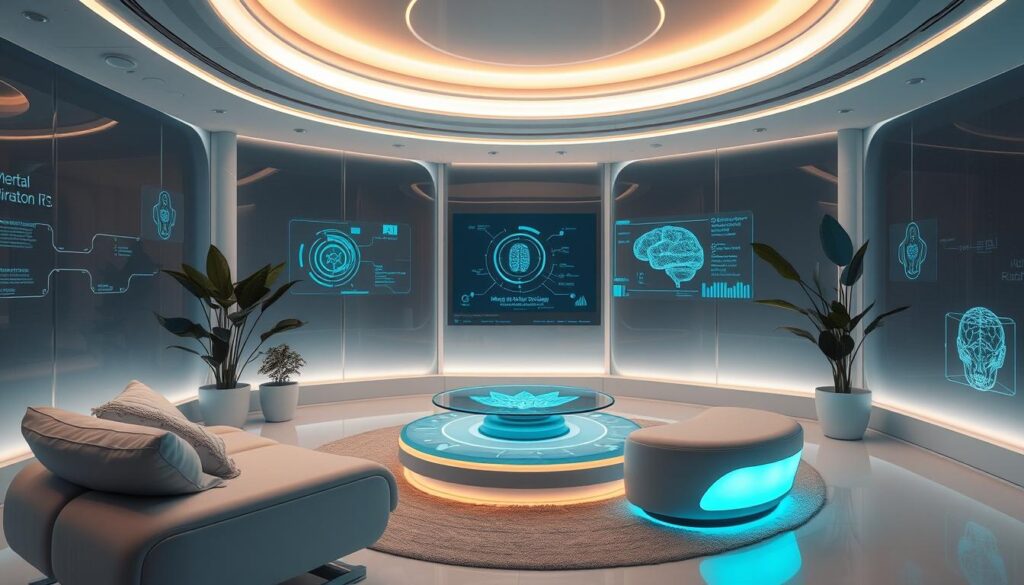
The world of mental health is changing fast, thanks to new tech. AI agents are leading this change, bringing big benefits to care and support. These smart systems are a new way to tackle mental health issues.
Defining AI Agents
AI agents are advanced autonomous systems that can see and act on their surroundings. In mental health, they use smart algorithms to understand patients, spot emotional signs, and offer help.
- They can talk to patients all day, every day.
- They handle complex mental health data.
- They give insights that are just for each patient.
The Role of AI in Healthcare
AI is changing healthcare by making it more flexible and caring. These smart agents are changing how we care for patients with new ways to watch and help.
| AI Agent Capability | Mental Health Impact |
|---|---|
| Continuous Monitoring | Track mood changes and behavioral patterns |
| Personalized Interventions | Develop tailored treatment recommendations |
| Natural Language Processing | Understand emotional nuances in communication |
Benefits and Challenges of AI in Psychiatry
AI agents have a lot of promise, but they also bring challenges. Ethical considerations are key in making these technologies. We must protect patient privacy and keep care human.
- They can make diagnoses more accurate.
- They make treatment more accessible.
- They can help early on.
Healthcare workers need to work with AI. It should help, not replace, the care and understanding that humans offer.
The Importance of Personalized Treatment
Personalized medicine is changing healthcare, including psychiatric treatment. It uses Proactive AI and Goal-Driven AI Architectures. This lets doctors create treatments that fit each patient’s needs perfectly.

The old way of treating mental health is fading away. New tech lets doctors make plans that really work for each person. They look at genetics, environment, and lifestyle.
Understanding Personalized Medicine
Personalized medicine means making treatments just for each person. It includes:
- Genetic profile analysis
- Comprehensive medical history evaluation
- Real-time health monitoring
- Predictive risk assessment
How Personalization Improves Outcomes
AI makes treatments better. Studies show personalized care can boost results by 15-20%.
| Treatment Aspect | Traditional Approach | Personalized AI Approach |
|---|---|---|
| Diagnostic Accuracy | 70-80% | 90%+ |
| Treatment Response | Variable | Significantly Improved |
| Patient Satisfaction | Standard | 25% Higher |
Barriers to Implementing Personalized Plans
There are hurdles to using personalized care:
- Complex data integration
- Limited AI model sophistication
- Privacy and ethical concerns
- High implementation costs
The future of mental health care is in AI-driven personalization. It makes treatment more precise, effective, and focused on the patient.
Data Collection and Patient Profiles
The world of mental health diagnosis is changing fast. Artificial General Intelligence is making it possible to understand patients better than ever before. It does this by combining data in new ways.
Today, doctors use many sources to get a full picture of a patient’s health. Thanks to AI, they can create detailed profiles that go beyond what was possible before.
Gathering Patient Information
AI agents are now getting patient data in new ways:
- Digital health platforms
- Wearable device tracking
- Smartphone behavioral monitoring
- Electronic health records
Analyzing Behavioral Patterns
AI can spot small changes in behavior that might mean a patient’s mental health is shifting. It looks at lots of data to find these signs early.
| Data Source | Analyzed Metrics | Potential Insights |
|---|---|---|
| Smartphone Usage | Communication Patterns | Social Interaction Assessment |
| Wearable Devices | Sleep Cycles | Mood Regulation Indicators |
| Voice Analysis | Speech Characteristics | Emotional State Evaluation |
Integrating Genetic and Biological Data
AI is great at handling complex genetic data. It finds genetic clues that old methods miss. This helps in making treatments more precise.
AI combines all kinds of data to make detailed profiles. This lets doctors give treatments that really fit each patient’s needs.
AI Algorithms in Treatment Recommendations
The world of psychiatric care is changing fast thanks to smart AI systems. AI-powered predictive models are changing how doctors create treatment plans for each patient.
Now, intelligent agents are key in looking at patient data. They use machine learning to suggest the best treatments. These AI systems can look at lots of data and find patterns that humans might miss.
Machine Learning and Predictive Analytics
AI is leading to better predictive models. These models can:
- Analyze past treatment results
- Find the best treatment for each patient
- Predict how well a treatment will work
Natural Language Processing for Patient Interaction
Natural language processing lets AI understand subtle nuances in what patients say. It can spot early signs of mental health issues with great accuracy.
| AI Capability | Patient Interaction Impact |
|---|---|
| Speech Pattern Analysis | 95% Accuracy in Detecting Emotional States |
| Real-Time Communication Assessment | 40% Increase in Patient Engagement |
Customizing Treatment Plans in Real-Time
Advanced AI agents can watch how patients do and change treatment plans as needed. This makes treatment more effective and less hit-or-miss.
By using smart algorithms and lots of patient data, these systems are making mental health care better and more tailored to each person.
Case Studies of AI in Psychiatric Care
The use of Proactive AI in psychiatric care has opened new doors for mental health treatment. Goal-Driven AI Architectures are changing how mental health professionals care for patients. They offer new insights into how to treat patients.
Research shows AI can greatly help in mental health treatments. Recent studies have shown big improvements in AI-assisted psychiatric care:
- AI models are 21% to 100% effective in diagnosis.
- AI could save healthcare up to 150 billion USD by 2026.
- AI is more accurate in finding psychiatric disorders.
Successful Implementation Examples
AI has shown great success in psychiatric care. Neuroimaging analysis now helps create personalized brain treatments like TMS. This has greatly improved mood disorder treatments.
Patient Feedback and Outcomes
Patients have mostly positive experiences with AI in mental health. Studies show AI self-guided treatments have good results. They have dropout rates similar to traditional treatments.
Lessons Learned
Important lessons from AI in psychiatric care include:
- Always watch how patients react to AI.
- Keep humans in charge of AI systems.
- Keep patient data safe.
The future of psychiatric care combines AI with human care. This will lead to more personalized and effective treatments.
Ethical Considerations in AI Psychiatry
The use of AI Agents in mental health care raises big ethical questions. As Artificial General Intelligence changes how we treat mental health, doctors face tough choices. They must protect patient rights while dealing with these new challenges.
Modern mental health care uses Machine Autonomy, which worries many about privacy, bias, and consent. The fast growth of AI tech means we need a strong plan for ethical use.
Patient Privacy and Data Security
Keeping mental health info safe is a top priority. Important steps include:
- Encrypting patient data
- Implementing strict access controls
- Ensuring compliance with HIPAA regulations
- Minimizing data collection
AI Bias and Its Implications
AI bias is a big problem in psychiatric care. Studies show up to 50% of underrepresented groups might face unfair treatment because of biased data.
| Bias Type | Potential Impact |
|---|---|
| Selection Bias | Skewed treatment recommendations |
| Representation Bias | Inadequate understanding of diverse patient experiences |
| Historical Bias | Perpetuating systemic healthcare inequities |
Ensuring Consent and Transparency
Informed consent is key when AI Agents help with mental health care. But, only 40% of AI developers share clear info about their algorithms. This shows we need better communication.
Doctors must make sure patients understand how AI will be used in their care. This is essential for trust and effective treatment.
The Future of Psychiatry with AI Agents
The world of psychiatric care is on the edge of a big change. This change comes from intelligent agents and self-motivated AI systems. As mental health issues keep growing, AI is set to change how we treat them.
New technologies are changing how we see and treat mental health. Intelligent agents are getting smarter and can do more than old tools.
Breakthrough Technologies in Mental Health Care
- Advanced neuroimaging techniques with AI analysis
- Brain-computer interfaces for precise diagnostic insights
- Personalized digital therapeutics powered by machine learning
- Predictive analytics for early mental health intervention
Potential Transformation in Treatment Paradigms
Self-motivated AI systems are opening new doors for personalized mental health care. They can look at many things like behavior, genes, and psychology. This helps create detailed plans for treatment.
Predictions for the Next Decade
Research shows AI could make a big difference in psychiatric care. About 50% of patients feel more at ease talking about mental health with AI. It’s expected that AI could make treatments 30% more effective in the future.
Even with challenges, like ethics, AI in psychiatry is very promising. Working together, humans and AI will shape the future of mental health care.
Collaborating with AI Agents: A New Model for Psychiatrists
The mental health field is changing fast with Proactive AI and Goal-Driven AI Architectures. Mental health experts are finding new ways to use artificial intelligence. They are changing how they treat patients.
Autonomous Decision-Making technologies are changing how psychiatrists work. AI doesn’t replace human skills but makes them better. It makes complex tasks easier.
Redefining Professional Roles
Mental health professionals are changing how they work. AI agents help psychiatrists by:
- Doing routine paperwork
- Looking at complex patient data
- Giving quick diagnostic ideas
- Lessening paperwork work
Training and Adaptation Strategies
Now, psychiatric training includes AI. It helps doctors work well with smart systems. Important skills include:
- Understanding data
- Using AI ethically
- Knowing how machine learning works
- Keeping care focused on people
Integrating AI into Treatment Methods
| Traditional Approach | AI-Enhanced Approach |
|---|---|
| Manual patient checks | AI finds patterns |
| Looking at limited data | Getting deep insights |
| Simple treatment plans | Custom plans that change |
By using AI, psychiatrists can spend more time with patients. They use AI’s advanced analysis to help patients more.
Conclusion: The Promise of AI in Personalized Psychiatry
The world of psychiatric care is changing fast thanks to AI agents and Artificial General Intelligence. These advancements bring new tools to help doctors improve diagnosis and treatment plans. AI is showing great promise in tackling the tough issues in mental health, like symptoms that don’t go away in nearly 39% of patients.
Machine learning and natural language processing are changing how doctors assess patients. They can now look at behavior, genes, and brain data with great detail. This helps doctors create treatments that are more likely to work, cutting down on trial and error.
AI can also predict when a patient might get worse, spotting over 70% of at-risk cases. This means doctors can act early to prevent problems. It’s a big step forward in helping patients.
It’s important to remember that AI is meant to work with doctors, not replace them. To use AI well, doctors need to keep learning, think about ethics, and use these tools responsibly. As AI gets better, it will help doctors understand and treat mental health issues even better.
The future of mental health care depends on more research, strong ethics, and focusing on what patients need. By keeping up with AI and using it wisely, doctors can give better care to more people.

Leave A Comment