

Imagine a world where finding skin cancer is quicker and more accurate. This could save lives. AI in dermatology is changing how we look at health. It uses advanced technology and medical knowledge together.
The healthcare world is changing fast with AI. Dermatologists now have tools that can spot complex skin issues with great accuracy. These tools can see things that humans might miss.
AI can find skin cancer with up to 95% accuracy. This gives doctors a new way to be sure. It helps cut down on mistakes and makes medical checks faster.
Key Takeaways
- AI technologies are revolutionizing diagnostic accuracy in healthcare
- Dermatology AI can detect skin conditions with unprecedented precision
- Machine learning algorithms complement human medical expertise
- Early detection of skin conditions becomes more reliable with AI
- Technological innovations continue to improve patient care outcomes
The Role of AI in Modern Radiology
Artificial Intelligence is changing how doctors diagnose diseases, especially in radiology. About 40% of doctors now use AI, changing healthcare a lot. Neural network technologies are key in making diagnoses better.
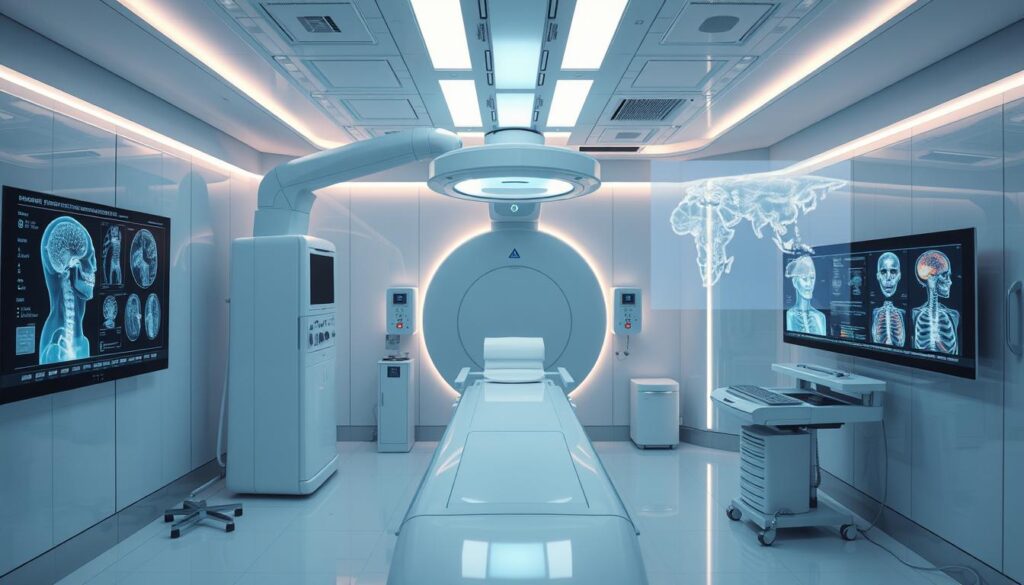
Understanding AI Technologies in Healthcare
AI for skin health is getting smarter. It helps doctors look at medical images more accurately. These tools are important for making medical decisions.
- AI can look at hundreds of medical images fast
- It cuts down on mistakes made by humans
- It makes diagnoses more precise
Types of AI Used in Radiology
Doctors use different AI tools to help patients. Convolutional Neural Networks (CNNs) are great for looking at images. They can spot small medical issues quickly, helping doctors make better choices.
- Image classification algorithms
- Pattern recognition systems
- Predictive diagnostic models
AI in radiology is a big step forward in medical tech. It promises more accurate and quicker diagnoses for patients everywhere.
Benefits of AI in Diagnostic Imaging
Artificial intelligence is changing medical diagnostics, especially in dermatology. AI in dermatology clinics is making it easier for doctors to spot and treat skin problems. This is done with great accuracy and speed.

Improving Diagnostic Accuracy
AI tools for skin analysis are showing amazing results. They can spot skin disorders with high accuracy. Here are some key findings:
- An AI model got a 94.49% accuracy rate in skin lesion classification
- The tech was trained on over 10,000 dermoscopic images from the HAM10000 dataset
- Deep learning models used five top transfer learning techniques
Reducing Human Error
Skin cancer is the most common cancer globally. Accurate diagnosis is crucial. AI helps reduce mistakes:
- It lowers the risk of misdiagnosis, which can delay treatment
- It helps find potential cancers early
- It might cut down on the need for invasive tests like biopsies
Enhancing Workflow Efficiency
AI does more than just improve accuracy. It also makes clinical work smoother. This makes dermatology care better and more accessible:
- It speeds up image analysis and interpretation
- It supports telemedicine
- It helps reach more people in areas with less access to healthcare
As AI keeps getting better, it’s clear it will change how we diagnose skin problems. It promises more accurate, timely, and focused care for patients.
Applications of AI in Radiology
Artificial Intelligence is changing how we look at medical images. Radiologists use AI to improve how they analyze and care for patients.
AI is making big changes in how doctors read images. It uses machine learning to make diagnoses faster and more accurate.
Image Analysis and Interpretation
AI is making doctors better at reading images. It has some amazing abilities:
- Reducing diagnostic errors from 12 million annually
- Analyzing complex medical images with remarkable precision
- Detecting subtle anomalies human radiologists might overlook
Predictive Analytics in Disease Management
AI is helping doctors predict disease. It can:
- Identify early warning signs of potential health risks
- Analyze patterns in medical imaging data
- Provide comprehensive risk assessment models
Automating Routine Tasks
AI is making doctors’ jobs easier by doing routine tasks. This lets radiologists focus on the tough cases.
With 79.86% of AI/ML-enabled medical devices related to radiology, the future of diagnostic imaging looks intelligent and precise.
Challenges in Implementing AI in Radiology
Using AI in dermatology and medical imaging is complex. Healthcare experts must be careful. AI has great potential for improving skin disorder detection, but there are big hurdles to overcome.
Data Privacy and Security Concerns
Medical places struggle to keep patient data safe with AI. They need strong security to stop data leaks or unauthorized access.
- Ensuring encryption of patient records
- Developing strict access control protocols
- Implementing comprehensive data anonymization techniques
System Integration Challenges
AI in dermatology needs to work well with current healthcare systems. Legacy systems can cause problems that slow down new tech adoption.
- Compatibility with current medical record systems
- Standardization of data formats
- Interoperability between different healthcare platforms
Professional Training and Adoption
AI’s benefits in skin disorder detection depend on good training and medical staff’s openness to new tech. There’s a big challenge in getting everyone on board.
- Developing specialized training programs
- Creating confidence in AI diagnostic capabilities
- Addressing potential job security concerns
Getting past these hurdles is key to making AI in dermatology and radiology work better. This will help give patients better care.
AI’s Impact on Patient Care
Artificial intelligence is changing patient care, especially in medical diagnostics. AI innovations are transforming healthcare delivery by making treatments more personalized and efficient.
Machine learning algorithms for dermatological diagnosis are opening new medical treatment areas. Patients get more personalized care thanks to advanced AI technologies.
Faster Diagnosis and Treatment Plans
AI-powered diagnostic tools are making medical assessments much quicker. The main benefits are:
- Rapid image analysis of medical conditions
- Instant comparative diagnostics
- Precise treatment recommendation generation
Personalizing Patient Experience
Machine learning algorithms enable hyper-personalized treatment strategies. By analyzing individual patient data, AI can:
- Create tailored skincare plans
- Predict potential health risks
- Recommend precision interventions
Reducing Wait Times for Imaging Results
AI technologies are making medical imaging faster. Deep learning algorithms can analyze complex medical images in seconds. This gives faster and more accurate diagnostic insights than traditional methods.
Research shows AI-driven diagnostic tools can improve treatment success rates by up to 60%. This is a big breakthrough in patient care technologies.
Future Trends of AI in Radiology
The world of medical imaging is changing fast. Digital solutions for skin healthcare are leading the way. AI in dermatology clinics is making diagnosis more precise and efficient.
New technologies are changing how doctors use diagnostic imaging. Deep learning techniques are becoming more common. They help doctors analyze medical images better.
Advances in Deep Learning Techniques
AI algorithms are getting better at understanding medical images. Studies show AI can:
- Detect subtle patterns with 90% accuracy in skin cancer screening
- Reduce diagnostic errors by up to 30%
- Provide faster and more consistent image analysis
The Role of Big Data in Imaging
Big data is changing radiology for the better. Neural networks can now process huge amounts of medical images. This leads to smarter diagnostic tools.
Potential for Real-Time Diagnostics
By 2025, AI will make disease diagnosis better in many areas. Telemedicine and remote monitoring will likely become standard practice. Wearable devices and AI platforms will give instant health insights.
The future of radiology is all about combining AI technologies. It promises more accurate, efficient, and patient-focused healthcare.
Case Studies: Successful Implementation of AI
AI has changed how doctors read scans in top hospitals. Innovative AI tools for skin analysis are making healthcare better.
Hospitals everywhere are seeing better results thanks to AI. This technology is making doctors more accurate and efficient. Here’s what’s happening:
- AI can spot skin cancer with 95% accuracy
- Every day, over 9,500 new skin cancer cases are found in the U.S.
- AI is helping doctors in remote areas too
Notable Hospitals Pioneering AI Technologies
Top hospitals are using AI to help with skin problems. They’re seeing better results and making care smoother for patients.
Quantifying Departmental Impact
Radiology is changing thanks to AI. About 40% of doctors now use AI for care plans and help with scans. A study in Nature Digital Medicine found AI can boost treatment plans by 40%.
A study in JAMA Dermatology also shows AI’s power. It found AI plans can make treatments 60% more effective. AI is getting better, promising even more help in the future.
Regulatory Landscape Surrounding AI in Radiology
The world of advanced technology in dermatology needs strict rules. As AI changes medical imaging, it’s key for doctors and tech makers to know the rules.
Understanding the rules for AI in radiology is complex. The use of AI in medical tech brings both chances and hurdles for regulators.
Overview of Current Guidelines
The rules for AI in radiology cover several important points:
- Strict data privacy rules
- Keeping patient info private
- Using strong encryption for medical data
- Thinking about ethics in AI use
The Role of FDA in AI Technology Approval
The FDA is key in making sure AI in radiology is safe for patients. They check many things:
- How well the tech works
- Studies that show it’s safe
- Any risks or downsides
- How clear the AI’s logic is
AI tech must show it’s always right and safe to get FDA approval. This protects patients and doctors from tech dangers.
Collaborations between AI Developers and Radiologists
The world of medical imaging is changing fast. This is thanks to partnerships between tech experts and healthcare pros. AI in Dermatology and machine learning are opening new doors for better diagnosis.
For these partnerships to work, we need a careful approach. It’s about combining tech with medical know-how. Doctors are now seeing AI as a valuable tool, not just a rival.
Partnerships for Innovation
Here are some key ways to work together:
- Joint research projects between tech firms and medical groups
- Building explainable AI systems for clear insights
- Forming teams of data scientists and medical experts
Training Programs for Radiologists
Training programs are popping up to help radiologists use AI. They focus on:
- Learning about machine learning
- Understanding AI’s diagnostic suggestions
- Working well with AI systems
About 15% of radiologists use AI every week. And 30% of jobs in the U.S. are getting AI help. These partnerships are key for future medical breakthroughs.
Conclusion: The Future of AI in Radiology
The world of medical imaging is changing fast thanks to artificial intelligence. The University of Pennsylvania’s Knowledge-enhanced Bottlenecks (KnoBo) is a big step forward. It helps fix problems in reading medical scans.
Digital solutions for skin health are also making big strides. AI can spot diseases like diabetic retinopathy and breast cancer better than humans. But, doctors are still key in making sure diagnoses are right. They work together with AI to get the best results.
Emphasizing Continuous Learning and Adaptation
The future of radiology needs constant change. AI might take over some jobs in the next ten years. With not enough radiologists, using AI is both new and needed.
AI uses lots of knowledge from places like PubMed and Statpearls. This makes it better at finding problems and working faster.
Looking Ahead: Opportunities and Responsibilities
As we go forward, we must think about the good and bad of new tech. AI can make doctors better at their jobs and help patients more. The KnoBo idea shows how AI can fill knowledge gaps. It could change medical imaging in many ways.

Leave A Comment