

The world of elderly care is changing fast, thanks to smart software and AI agents. As people live longer and family care models change, new healthcare tech is filling the gaps in senior support.
AI agents are becoming key players in patient care. They bring new levels of health monitoring, accurate diagnoses, and tailored treatments. These smart tools are more than just tech; they’re caring friends in the complex world of geriatric medicine.
AI is making healthcare better by making it more efficient, accurate, and caring. It helps doctors keep a close eye on patients’ health and predict future problems. AI agents are leading to a new era of proactive and personalized care for seniors.
Key Takeaways
- AI agents revolutionize elderly care through advanced monitoring technologies
- Intelligent software enhances diagnostic accuracy and personalized treatment
- Healthcare professionals can optimize patient care using AI-driven insights
- Predictive analytics help prevent future health issues
- AI technologies reduce administrative work in geriatric medicine
Understanding AI Agents in Healthcare
The healthcare world is changing fast with new AI tech. AI agents are making big changes in medical. They bring advanced systems that help patients and make things run smoother.

AI agents are the latest in tech for healthcare. They use smart tech like Natural Language Processing and Conversational AI. This lets them do complex tasks very well.
Defining AI Agents in Medical Context
AI agents are smart software that can do things on their own. They look at data and make smart choices. In healthcare, they show up in many new ways:
- Virtual health assistants
- Diagnostic support systems
- Patient monitoring technologies
- Administrative workflow optimization tools
The Transformative Role of AI in Medicine
AI agents are making a big difference. A Deloitte study found 62% of patients are okay with AI health assistants. These tools could save the U.S. healthcare system up to $150 billion a year by making things more efficient.
| AI Agent Capability | Healthcare Impact |
|---|---|
| 24/7 Patient Support | Continuous Healthcare Accessibility |
| Medical Image Analysis | 98% Diagnostic Accuracy |
| Administrative Automation | Up to 30% Cost Reduction |
Conversational AI makes talking to healthcare systems easier. It understands natural language. This means patients can get answers to complex questions and get info that’s just for them.
The future of healthcare is bright with these smart systems. They keep getting better and better. This means we’ll see more accurate, efficient, and caring medical services.
The Importance of Geriatric Medicine
The world’s healthcare is changing fast because of a big shift in demographics. As more people get older, the need for special care for the elderly grows. Virtual assistants and chatbots are new ways to help meet these needs.
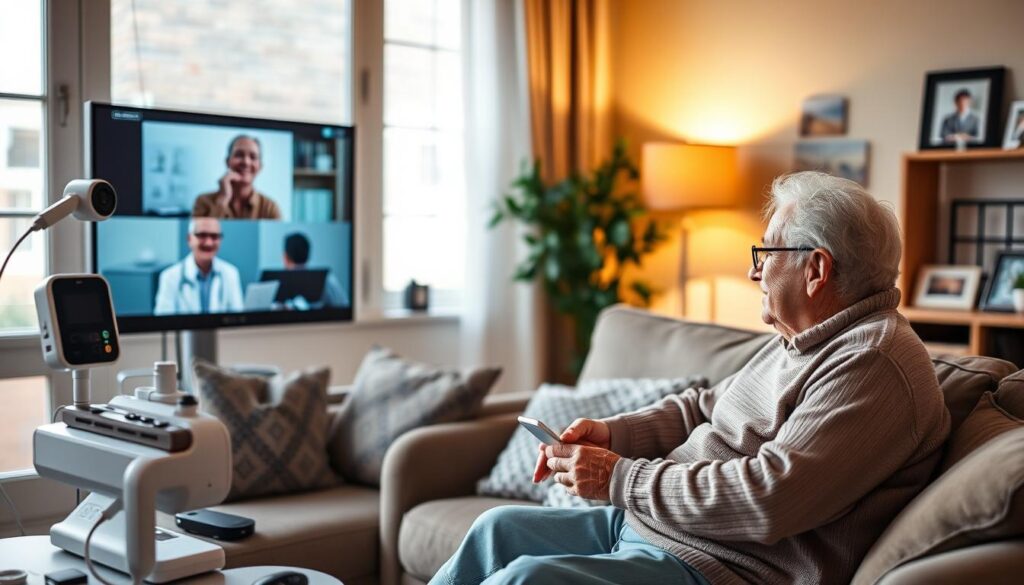
The aging population brings unique health challenges. We need care plans that can adapt to these changes. Here are some interesting facts about where the elderly live:
- 90% of elderly individuals live independently
- 7% receive community care
- 3% reside in nursing homes
Unique Challenges in Geriatric Care
Geriatric medicine deals with many health issues that regular medicine can’t handle. Chronic condition management, keeping minds sharp, and improving quality of life are key. Virtual assistants are helping both doctors and patients a lot.
The Rising Aging Population
Looking ahead, the world will see a big increase in older people. By 2050, there will be 2.1 billion people aged 60 and older. Chatbots and AI are becoming key in meeting this growing need for healthcare.
| Demographic Indicator | 2019 | 2050 Projection |
|---|---|---|
| Population 60+ Years | 1 Billion | 2.1 Billion |
| Elderly Preference for AI Solutions | N/A | 83% |
Using advanced tech like virtual assistants and chatbots is a promising way to meet the healthcare needs of an aging world.
How AI Agents Support Healthcare Professionals
Healthcare workers are dealing with a lot of challenges. They have to manage complex patient care and handle a lot of paperwork. AI agents are becoming key helpers in making medical work easier. They help cut down on paperwork and make better.
Systems that talk and understand language are changing how doctors and nurses work. They make it easier to handle patient info and make their day-to-day tasks more efficient.
Streamlining Administrative Tasks
AI is making life easier for healthcare workers. It’s helping them focus more on patients and less on paperwork. Here are some ways AI is making a difference:
- 30% less waiting time for patients
- 20% more time for patient care
- Automated patient records
- Smart scheduling and appointment systems
Enhancing Decision-Making Processes
AI is also changing how doctors make decisions. It uses advanced analysis and predictions. This leads to:
- 45% better diagnosis
- Quick access to complex medical data
- Real-time risk checks
- Custom treatment plans
| AI Agent Capability | Impact on Healthcare |
|---|---|
| Workflow Optimization | Reduces paperwork by 40% |
| Predictive Analytics | 25% fewer emergency visits |
| Patient Data Management | 35% faster data access |
AI agents are a big step forward in healthcare. They help doctors and nurses give better, more focused care.
AI Agents and Patient Monitoring Systems
The healthcare world is changing fast with new AI agents. Advanced monitoring technologies are making it easier to track health from afar. This is great for keeping elderly patients safe and healthy.
Machine Learning is key in making smart patient monitoring systems. These AI agents can watch over vital signs, spot health dangers, and share updates with doctors right away.
Remote Health Monitoring Technologies
Today’s remote monitoring tech is amazing for keeping an eye on patient health:
- Wearable devices that keep track of heart rate and activity
- Smart home sensors that watch for falls and movement
- AI platforms that analyze health data in detail
Benefits for Elderly Patients
The use of AI agents in healthcare helps elderly patients a lot:
- They can stay independent with ongoing health checks
- They can catch health problems early
- They need to go to the hospital less often
- They get health advice that’s just for them
AI agents could save the healthcare industry up to $150 billion by 2026. These technologies are changing how we care for older adults. They lead to better health results and make things run smoother.
Improving Diagnosis with AI Agents
The world of medical diagnostics is changing fast thanks to intelligent software and new tech. AI agents are making a big difference in how doctors solve tough diagnostic problems, mainly in geriatric medicine.
Artificial intelligence is becoming a key tool in medical diagnostics. It can analyze complex medical data like never before. Thanks to Natural Language Processing, AI can understand detailed medical info with great accuracy.
Machine Learning for Accurate Diagnosis
Machine learning algorithms bring big benefits to diagnostics:
- They quickly analyze medical images
- Spot subtle disease patterns
- Do predictive risk assessments
- Find health risks early
Case Studies in Geriatric Diagnostics
Real-world examples show how AI can help in healthcare diagnostics:
| Diagnostic Area | AI Contribution | Accuracy Improvement |
|---|---|---|
| Cognitive Decline | Pattern Recognition | 35% Earlier Detection |
| Chronic Disease Screening | Comprehensive Data Analysis | 42% Enhanced Precision |
| Medical Imaging Interpretation | Advanced Neural Networks | 50% Faster Diagnosis |
The future of geriatric medicine is all about using AI to help doctors. This way, we can get more accurate, timely, and personalized care.
AI Agents in Personalized Treatment Plans
Personalized healthcare is changing geriatric medicine a lot. It uses advanced Conversational AI and Virtual Assistants. These smart systems are changing how doctors plan and carry out treatments for older patients.
Today’s AI agents are great at making healthcare plans that fit each patient’s needs. They look at all the patient’s data. Then, they make precision-driven treatment plans that change as needed.
Customizing Healthcare for Individual Needs
AI-powered solutions are amazing at making medical care personal:
- They dig deep into patient medical history
- They suggest medicines that fit each patient
- They spot health risks based on each patient’s profile
- They change treatment plans as needed
Tracking Patient Progress over Time
Virtual Assistants now keep an eye on patient health all the time. They can:
- Keep track of how patients are doing
- Notify doctors about big changes
- Suggest actions to take early
- Keep up-to-date digital health records
Studies show AI-driven plans can cut hospital readmissions by about 25%. This shows how much AI can change care for the elderly.
AI Agents Enhancing Communication
The world of healthcare communication is changing fast with new AI tech. Dialogue systems and chatbots are making it easier for older patients to talk to doctors. This makes medical care more accessible and quick to respond.
Modern AI agents are changing how we talk in geriatric medicine. They use advanced AI systems to offer personalized, multilingual support. This meets the needs of many patients.
Facilitating Patient-Provider Conversations
- 24/7 availability for patient inquiries
- Instant response to medical questions
- Simplified medical information translation
- Consistent communication channels
Multilingual Support Features
Chatbots in healthcare now speak many languages. For example, Emma in Amarillo, Texas, helps communities with different languages.
| AI Communication Benefit | Impact Percentage |
|---|---|
| Appointment Booking Rates | 30% Increase |
| Patient Satisfaction | 40% Improvement |
| Administrative Task Reduction | 70% by 2025 |
By using smart dialogue systems, healthcare providers can make communication better for older patients. This leads to better care and understanding.
Ethical Considerations in Geriatric AI Use
Using Language Models and Machine Learning in geriatric care raises big ethical questions. As AI gets smarter, doctors must find a balance between new tech and keeping patients safe.
Privacy Concerns with Data Collection
Collecting data for AI in healthcare is a big privacy issue. The amount of medical data is growing. We need strong security to keep elderly patients’ info safe. Important privacy points include:
- Securing personal health records
- Ensuring patient consent for data usage
- Protecting against unauthorized data access
- Maintaining confidentiality in digital health platforms
Addressing Bias in AI Algorithms
Machine Learning can sometimes show biases, which can harm elderly patients. It’s important to make sure the data used to train these algorithms is diverse and fair.
Big ethical challenges are:
- Preventing age-related algorithmic bias
- Ensuring equitable healthcare recommendations
- Promoting transparency in AI decision-making processes
- Implementing accountability mechanisms
Ethical guidelines must evolve alongside technological advancements to protect vulnerable populations and maintain the integrity of geriatric healthcare interventions.
Training Healthcare Professionals to Use AI
The fast growth of AI in healthcare needs a thorough training plan. Intelligent software is changing medical education. It offers new chances for healthcare workers to improve their skills and care for patients.
Developing Competency in AI Tools
Healthcare places are changing how they teach. They now use AI in learning. This makes education more interactive and tailored to each person.
- AI simulations provide immersive learning scenarios
- Virtual reality training increases skill retention by 30%
- Personalized learning paths boost student engagement by 50%
Continuous Education on AI Innovations
Medical staff must keep up with new AI tech. Here are some key facts about the need for ongoing AI learning:
| Training Metric | Percentage Impact |
|---|---|
| Diagnostic Teaching Improvement | 60% Enhanced by AI Tools |
| Reduction in Diagnostic Errors | 20% Decrease |
| Critical Clinical Skills Enhancement | 40% Improvement |
The future of medical education is tied to AI. Interdisciplinary training programs are key. They help professionals work well with AI, leading to better patient care and tech use.
With 75% of healthcare teachers seeing AI skills as vital, medical training is changing fast. This change is driven by new tech.
Integrating AI Agents into Existing Systems
Transforming healthcare tech needs smart strategies for AI agents. Companies face big hurdles when adding Conversational AI and Natural Language Processing to old medical systems.
Healthcare groups hit many roadblocks when adding AI agents. The process needs careful planning and knowing the tech limits.
Challenges in Adoption and Implementation
- Technical compatibility with legacy healthcare systems
- High-quality data requirements for training AI models
- Resistance from healthcare professionals
- Complex workflow integration
Successful Integration Strategies
Deploying AI agents well means using smart strategies. This way, you avoid big problems and use the tech’s full power. Phased implementation helps everyone get used to it slowly.
| Integration Stage | Success Metrics |
|---|---|
| Initial Deployment | 20-30% Automation Rate |
| Scalability | Consistent Resource Allocation |
| Long-term Adoption | 71% Executive Confidence |
Natural Language Processing makes AI talk smoothly with healthcare systems. Conversational AI technologies make smart interfaces that get and answer tough medical questions.
The future of healthcare tech depends on learning, adapting, and working together. AI and human experts need to team up.
Future Trends in AI Agents and Geriatric Medicine
The world of geriatric medicine is changing fast with new AI technologies. Innovative automation strategies are making virtual assistants and chatbots key in caring for the elderly. They promise big steps forward in healthcare.
The future of AI in geriatric medicine is very promising. By 2030, healthcare tech will change a lot, improving patient care and management.
Innovations on the Horizon
Here are some new trends in AI for geriatric care:
- Advanced virtual assistants that offer emotional support
- Personalized treatment plans based on genetics and lifestyle
- Real-time health monitoring with wearable tech
- Predictive diagnostic tools
Predictions for AI Adoption Rates
Studies show AI adoption in healthcare is growing fast. Chatbots will be key in managing chronic conditions for the elderly. They could cut hospital admissions by up to 20%.
| AI Technology | Projected Impact by 2030 |
|---|---|
| Virtual Assistants in Geriatric Care | 87% accuracy in patient monitoring |
| AI-Driven Diagnostic Tools | 30-50% reduction in ineffective treatments |
| Personalized Health Interventions | 25% reduction in administrative burdens |
The use of AI agents will change geriatric medicine. It will offer more personalized, efficient, and caring care for the elderly.
Conclusion: The Future of Geriatric Care with AI
The world of elderly care is changing fast thanks to new technologies. AI is making big changes in healthcare, like dialogue systems and language models. These tools are helping to solve big problems in caring for the elderly.
By 2050, there will be 2 billion older people worldwide. This means we need new ways to care for them that work better and help more people. AI can make healthcare more efficient and improve patient.
AI can help caregivers do their jobs better by up to 30%. It makes care more personal and responsive, which is great for older patients. These new technologies are changing how we care for the elderly, making care better and more effective.
Summary of Key Benefits
AI is making a big difference in caring for the elderly. It helps with paperwork and gives doctors better insights. This means healthcare for older people is getting better.
AI can quickly understand and use complex medical data. It can even suggest treatments that are just right for each patient. This is a big step forward in medical technology.
The Road Ahead for AI in Healthcare
As we look to the future, working together is key. We need healthcare experts, tech people, and leaders to make AI better. The goal is to help caregivers do their jobs better, not replace them.
With more research and careful use, AI can really help improve life for older people. It has the power to make care more efficient and caring.

Leave A Comment